
Borussia Dortmund: without Guirassy, the attack loses its anchor
His thigh injury against Betis is more than a team news update: it forces Dortmund to confront how much of its attack still depends on one reference point.
The game that exposed it
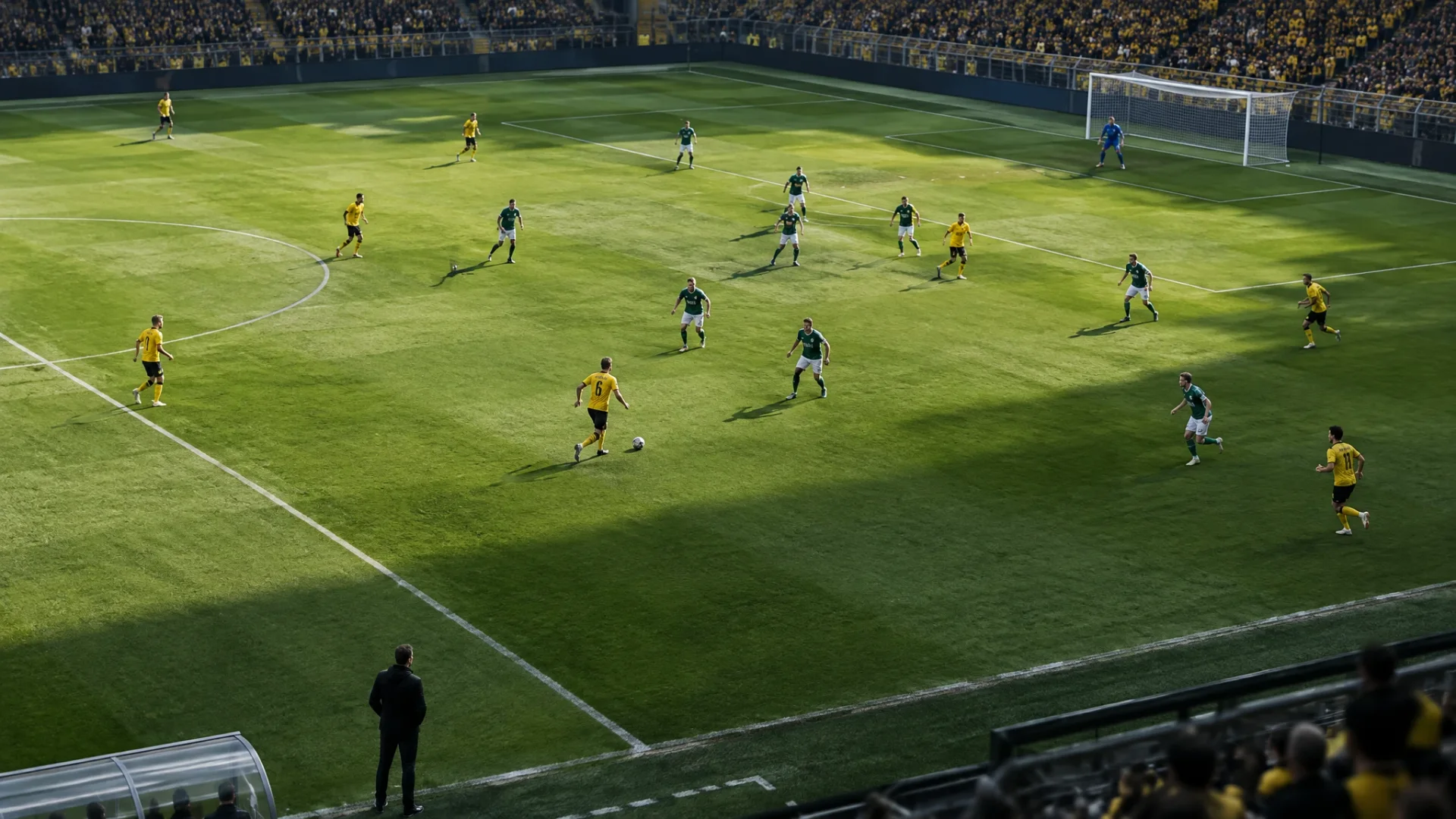
Borussia Dortmund beat Real Betis 2-1 in the Champions League league phase, but the evening carried a clear price: Serhou Guirassy went off injured in the 31st minute after a thigh problem. Niko Kovač then confirmed he would miss the next league match against Elversberg, with further handling still needed over the following days. [1][3]
The result matters. The image matters more. The moment the centre-forward disappears, Dortmund’s attack changes shape. It is not just that they lose a scorer; they lose the player who pins centre-backs, gives crosses a target and offers a stable point for every rushed possession. That is rarely glamorous football, but it is often the difference between structure and improvisation. []
Sources : [1] Bundesliga ↗[3] UEFA ↗
An attack that still depends on one body
The issue is not merely that a substitute misses a chance. It is that the entire attacking plan appears to bend around the moment Guirassy is unavailable. Against Betis, Dortmund ended up leaning on Fabio Silva for the opening goal and on Konstantinos Karetsas, who replaced the injured striker, for the winner. That detail matters: the match was decided by changes forced on the coach, not by an attack that could absorb the loss naturally. [2]
A serious team can survive without its centre-forward. A well-built one can even become more varied. Dortmund still looks as if it loses part of its vocabulary the second the main noun disappears. The problem is not only depth, but dependence on a single reference point. Without it, the other forwards must simultaneously run, pin, combine and finish. That is a lot to ask of a line already being asked to reinvent itself on the fly. []
Sources : [2] Sportschau ↗
Kovač and the maths of the role
For Kovač, this is not only a personnel problem but a calculation problem. With Guirassy available, Dortmund can live with direct play, contested balls and quick exits around a known target. Without him, everything becomes more theoretical: runs have to be better timed, the wide areas more aggressive, the second balls more carefully prepared. In short, the team has to become more collective exactly when it loses its simplest reference. []
That is where the real weakness of an attacking project shows up: not when it works, but when it has to keep working without its main piece. Dortmund may hope the absence is brief. The deeper question is harsher. If the attack still needs a crutch to remain legible, then the injury is not only Guirassy’s. It is the model’s dependence on its centre-forward. [1][2]
Sources : [1] Bundesliga ↗[2] Sportschau ↗
Read next
 Opinion
Borussia Dortmund’s cup escape was a blueprint first, a Sabitzer free kick second
The 3-2 win over Werder Bremen is not just a cup scare. The real question is whether Niko Kovač can keep the first-half intensity without inviting a second-half collapse.
 Lucien DelcourtItaly, Germany, Spain & Turkey
 Opinion
Borussia Dortmund’s Fan Mode asks a better question than bans: can rewards protect stadium atmosphere?
Dortmund is testing whether less phone use can be encouraged, not imposed. That matters because the club is trying to defend matchday feeling without turning supporters into content machines.
 Inès ValençaLatin America & world football
 Opinion
Leverkusen’s sterile possession met Marseille’s low block into focus
Why Bayer Leverkusen’s first Europa League defeat looks less like a talent crisis than a warning: against a deep block, the ball means little if decisions are too slow.
Lucien DelcourtItaly, Germany, Spain & Turkey Opinion
Trabzonspor-Freiburg: the real test is whether Freiburg can travel with a plan
In Trabzon, Freiburg must prove that the Monaco defeat did not break its structure: can it play away with a plan against a Turkish side already moving well in Europe?
Lucien DelcourtItaly, Germany, Spain & Turkey Opinion
Napoli in Porto: the diagnosis is broken, not just the squad
The 4-1 defeat in Porto did more than expose absences. It showed a club whose players no longer agree on what the crisis is, which is usually when a manager’s “we are together” line starts sounding like tape on a sinking ship.
Lucien DelcourtItaly, Germany, Spain & Turkey Opinion
VfB Stuttgart in Istanbul: the real test is the plan, not the noise
Against Galatasaray, Stuttgart are not only testing their nerve; they are asking whether a team built for transition can also survive when efficiency becomes a European asset.
Lucien DelcourtItaly, Germany, Spain & Turkey