
At Vallecas, Rayo’s shirt has become a bargaining tool
The promised return of the diagonal band shows a simple truth: in 2026, a shirt is no longer just a product. At Vallecas, visual identity has become leverage against the club.
The franja is not a detail
Rayo Vallecano has promised the return of its red diagonal band on the 2027-28 shirts, after seasons marked by a lightning motif introduced in 2021. All three kits, still made by Umbro, are due to feature the historic “franja” again. The shift is being framed as part of a tense relationship with supporters, after the club also met representatives of the fan base. [1]
That is not a design footnote. It is a reminder that, in modern football, the shirt remains a site of power. A kit tells us who decides, who gives way, and when a club realises it is not simply buying a visual style but touching belonging itself.
Sources : [1] Footpack ↗
Clothing as leverage
What happened at Vallecas goes beyond the return of a traditional motif. The Madrid club has not merely corrected an aesthetic mistake; it has acknowledged that part of its image slipped out of its hands once it collided with the people who wear it, sing it and defend it. When a shirt becomes the object of collective objection, it stops being a display item and becomes a test of legitimacy.
That is the real issue: priorities. Too many clubs still treat kits as interchangeable marketing surfaces. Rayo points in the opposite direction. In a supporters’ club, visual identity is not packaging. It is part of the moral contract with the crowd. The diagonal band is not just attractive or historic; it expresses continuity between club, neighbourhood and terrace culture.
The ADO Den Haag precedent
Rayo is not alone. ADO Den Haag abandoned a newly unveiled shirt shortly after criticism from supporters. Again, the pressure was not about the team’s sporting output, but about a visual choice judged unacceptable by the people who identify with the club. [2]
That precedent matters because it confirms a clear pattern: fans can still set a limit on club-brand creativity. A shirt remains a commercial object, yes, but it cannot detach itself completely from the community that gives it meaning. When the backlash is strong enough, the club has to choose between sellable image and lived identity. That is rarely a neutral choice.
Sources : [2] Dégaine ↗
Why supporters should care
For supporters, this is not cosmetic. It tells them whether the club sees its culture as heritage or as a product line. In an era of proliferating kits that increasingly look alike, a fight over one graphic detail may seem tiny. It is not. It shows who gets the final word on what the club is supposed to stand for.
Rayo shows that, in 2026, the shirt is no longer just branding. It can be leverage, a counterweight and a reminder. When a community pushes a club back toward its own shape, it is not asking for nostalgia for its own sake. It is demanding coherence. And in football, coherence is how you respect the people who keep the club alive long before the shop does.
Read next
 Opinion
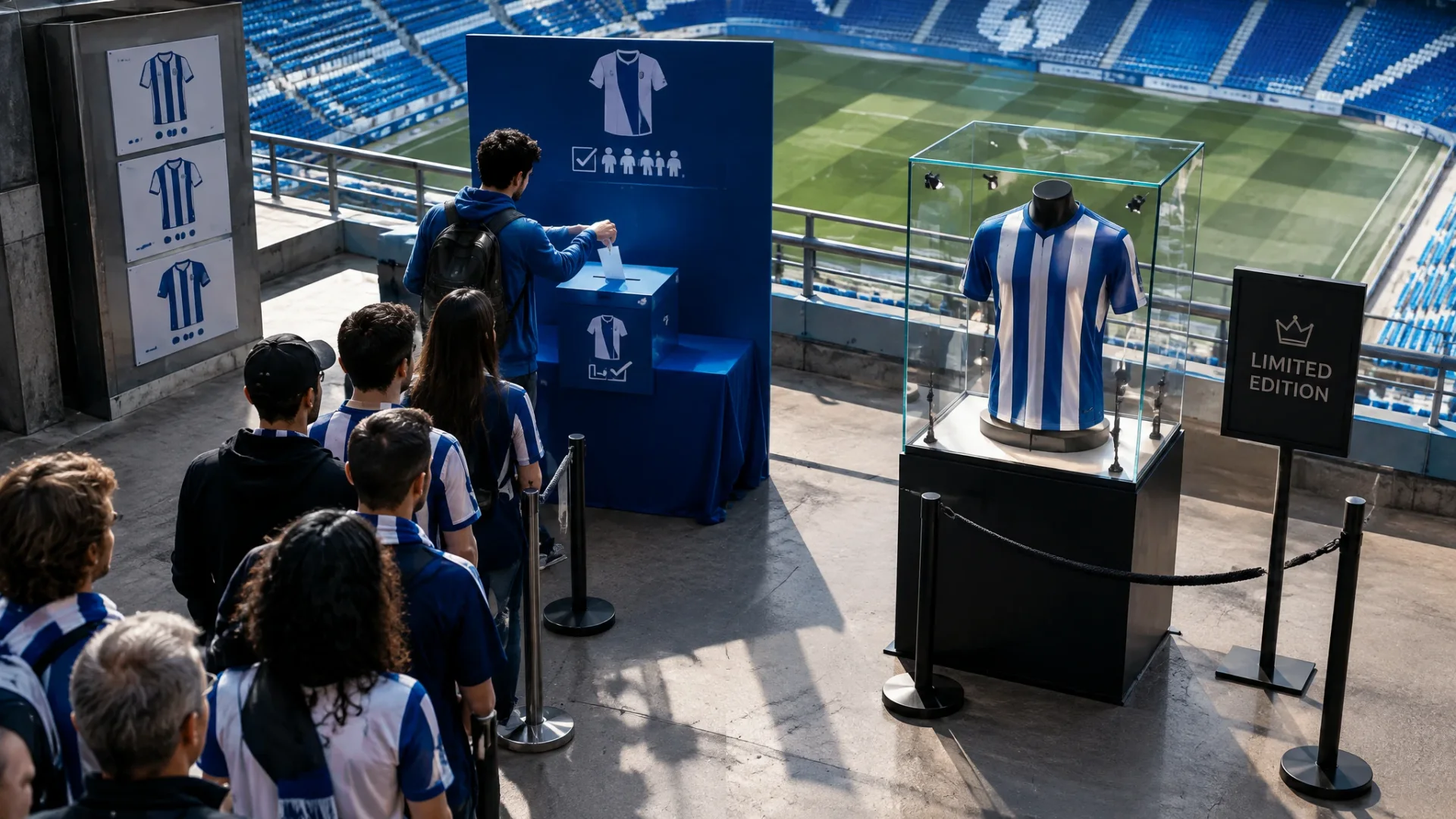
Espanyol’s shirt vote and the football-fashion economy of scarcity
Espanyol’s fan vote looks democratic. The bigger trend is still controlled rarity: clubs invite participation, brands keep the most desirable objects tightly managed.
 Basil ArtemoffTerraces, Marseille & style
 Opinion
LALIGA, Yamal and the making of a goal as slogan
Why does LALIGA’s monthly award for Lamine Yamal say as much about the league’s machinery as it does about Barcelona’s football?
 Lucien DelcourtItaly, Germany, Spain & Turkey
 Opinion
France, Mbappé and the prototype boot: elite football now looks like a rotating showroom
What does the November France boot census really tell us? That adidas still leads the floor, Nike is chasing, and On is turning Mbappé into a moving prototype display.
Basil ArtemoffTerraces, Marseille & style Opinion
OM 2026-2027: when the shirt becomes a system, and the list becomes a verdict
Dégaine now ranks kits the way football once ranked teams. In Marseille, OM is selling its 2026-2027 identity as a full package: logo, colours, reveal, store, versions. The question is no longer “is it nice?” but “what kind of club does this shirt make you want to watch?”
Basil ArtemoffTerraces, Marseille & style Opinion
Vinicius Jr, Nike Mercurial and the new shirt order: football style now works like a streetwear drop
Why do Vinicius Jr’s signature boot and a same-day shirt ranking tell the same story? Because football style now runs on the logic of streetwear: narrative, scarcity, hierarchy, desire.
Basil ArtemoffTerraces, Marseille & style Opinion
Lens vs OM in Ligue 1: Bollaert turned the night into memory and protest
What does a Lens–OM night become when Bollaert chooses remembrance, then dissent, while Marseille answer with a sizeable travelling end? Much more than a routine league fixture.
Basil ArtemoffTerraces, Marseille & style