
Lens vs OM in Ligue 1: Bollaert turned the night into memory and protest
What does a Lens–OM night become when Bollaert chooses remembrance, then dissent, while Marseille answer with a sizeable travelling end? Much more than a routine league fixture.
Bollaert did not offer a neutral backdrop
This Lens–OM was never going to be a generic football set. Before the game even settled into its sporting rhythm, Bollaert set a heavy mood, almost activist in tone. Lens ultras began by staying silent, then several banners targeted the team and Jean-Louis Leca after the collapse against Como. The stadium did not merely complain; it gave the unrest a clear shape. [1]
That matters because a match is never just the scoreline or the tactics board. When a stand chooses silence and then banners, it reminds you that supporter culture is not decoration. It is a language. Here, it spoke louder than routine slogans, and it refused to let the previous disappointment fade into background noise. [1]
Sources : [1] SoFoot ↗
The “Match of Memory” changed the cultural frame
Lens had also announced a second “Match of Memory” for OM’s visit. The club was due to wear a special kit linked to mining disasters, alongside a tribute to deceased supporters and the victims of mining catastrophes. The article says more than 1,500 names were submitted by relatives. This is no ordinary pre-match flourish: it is an entire club turning the fixture into an act of remembrance. [2]
That is where the game becomes heavier than whatever the final score might be. The danger, of course, is turning memory into a fixed display. But Lens appears to be tying the present tense of the match to a local, human history rather than flattening it into folklore. When a club leans into that frame, it asks the crowd to watch differently: not just who presses, who attacks, who wins, but what the stadium says about itself. [2]
Sources : [2] FootMarseille ↗
Marseille travel with their own supporter identity
On the Marseille side, the interest was not purely sporting. A local outlet reported around 1,000 OM fans were expected to travel to Lens, with the match coming only days after the European trip to Leverkusen. The number is not the point by itself; the point is that OM never truly travel alone. Their away following carries its own way of inhabiting the game. [3]
That presence changes the sensory balance of the night. Marseille usually bring not just volume, but a signature. Against a tense, reproachful Bollaert, ritualised through memory, OM’s travelling support was always likely to provide something else: echo, reply, contrast. In nights like this, away support shows its real value, because it does not merely accompany the team — it talks back to the home stadium. [3]
Sources : [3] Football Club de Marseille ↗
Why the real story is the atmosphere
In the end, this was never only a duel of formations or fresh legs. It was also a clash between two terrace cultures responding to the same fixture. Lens brought mourning, memory and protest; Marseille brought travelling loyalty and noise. Between them, football becomes a revealing instrument. That is not a decorative extra. It is the point. [1][2][3]
So it would be a mistake to read Lens–OM as just another Ligue 1 night. Whatever the result, it cannot erase the Lens stands’ anger or the memorial frame the club built around the match. This should be understood first as a confrontation of atmospheres, and only then as a line in the standings. In an era that moves too quickly, that kind of heaviness deserves to be taken seriously. [1][2][3]
Sources : [1] SoFoot ↗[2] FootMarseille ↗[3] Football Club de Marseille ↗
Read next
 Opinion
Lens–OM: a test of squad depth more than a clash of momentum
On Sunday night, the real question is not who comes in carrying form, but who copes best with absences: Lens lose Franjo Ivanović, while Marseille keep a stable defensive base but face uncertainty on one left-sided option.
 Étienne MorelThe football, the clubs, the decisions
 Opinion
OM at Lens: winning without getting carried away is the real test
What does Marseille’s win at Lens actually tell us? That the points matter, yes. But more importantly, that progress now means travelling well without turning two away wins into a victory lap.
 Basil ArtemoffTerraces, Marseille & style
 Opinion
Marseille and the Vélodrome: when the Nord stand becomes a tactical handicap
What is a team worth when it is finally playing better just as its stadium loses part of its voice? Marseille’s sanction is a reminder that a club cannot cleanly separate performance from stand-side disorder.
Étienne MorelThe football, the clubs, the decisions Opinion
Ligue 1 2027-2032: Marseille watches the TV-rights gamble with unease
The LFP has relaunched the bidding for Ligue 1’s 2027-2032 domestic rights. For OM, the real issue is not who bids, but how much value the next cycle can actually deliver.
Basil ArtemoffTerraces, Marseille & style Opinion
OM, PUMA and adidas boots: in Marseille, the shirt no longer runs the whole show
In Marseille, the shirt still matters. But the boots tell a different story: players now have far more autonomy than the club’s kit deal suggests.
Basil ArtemoffTerraces, Marseille & style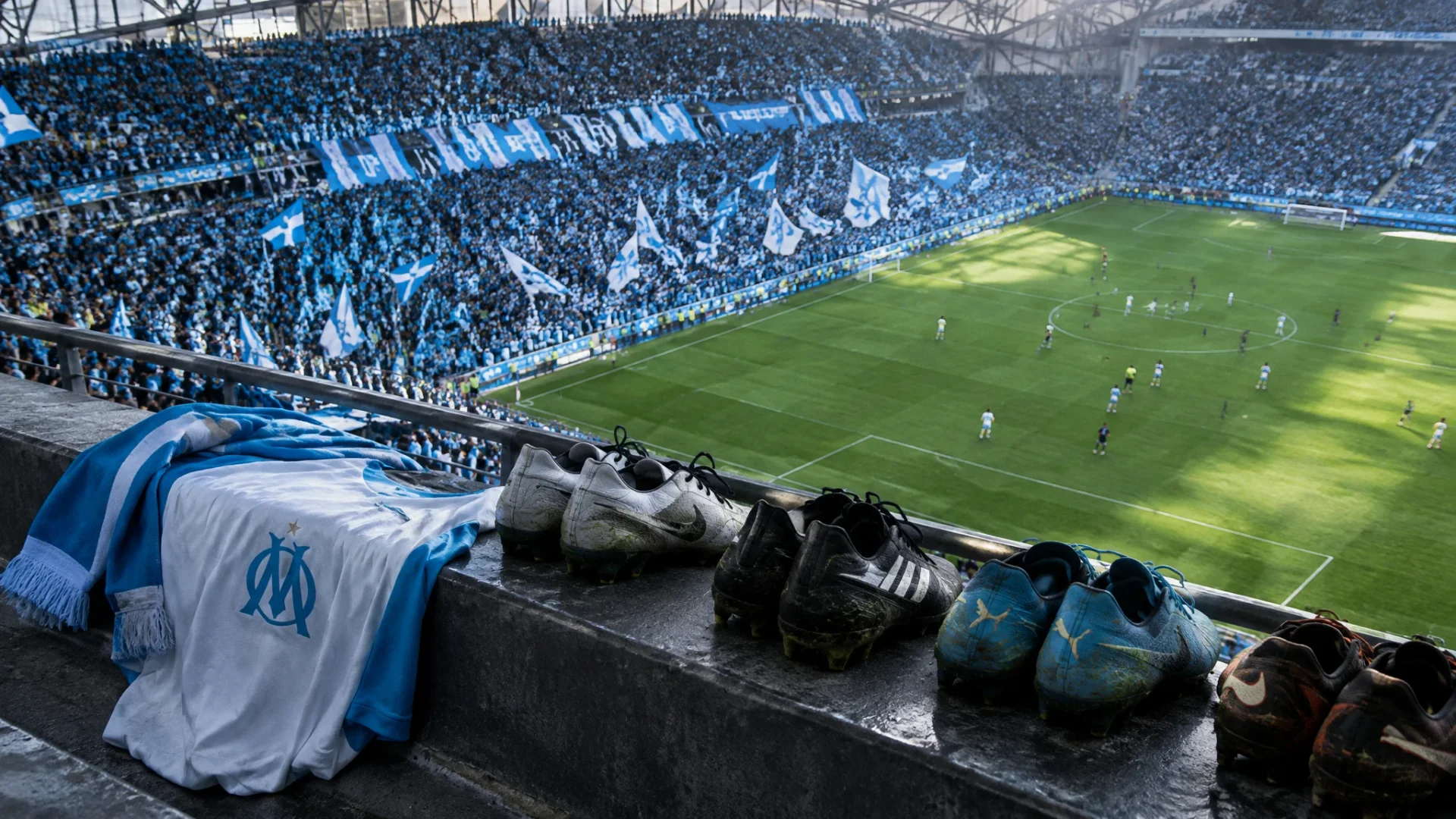 Opinion
OM in Ligue 1: the club brands the stands, not the boots
Why does Marseille still look unified in the curve, while the players’ feet tell a different story? Because the official image and the real dressing-room habits no longer match.
Basil ArtemoffTerraces, Marseille & style