
Fenerbahçe: the coach exit is a timing problem, not just a derby hangover
The defeat at Galatasaray hurt, but the real issue is the calendar: a managerial rupture lands between a cup midweek and a league weekend, with discipline still hanging in the air.
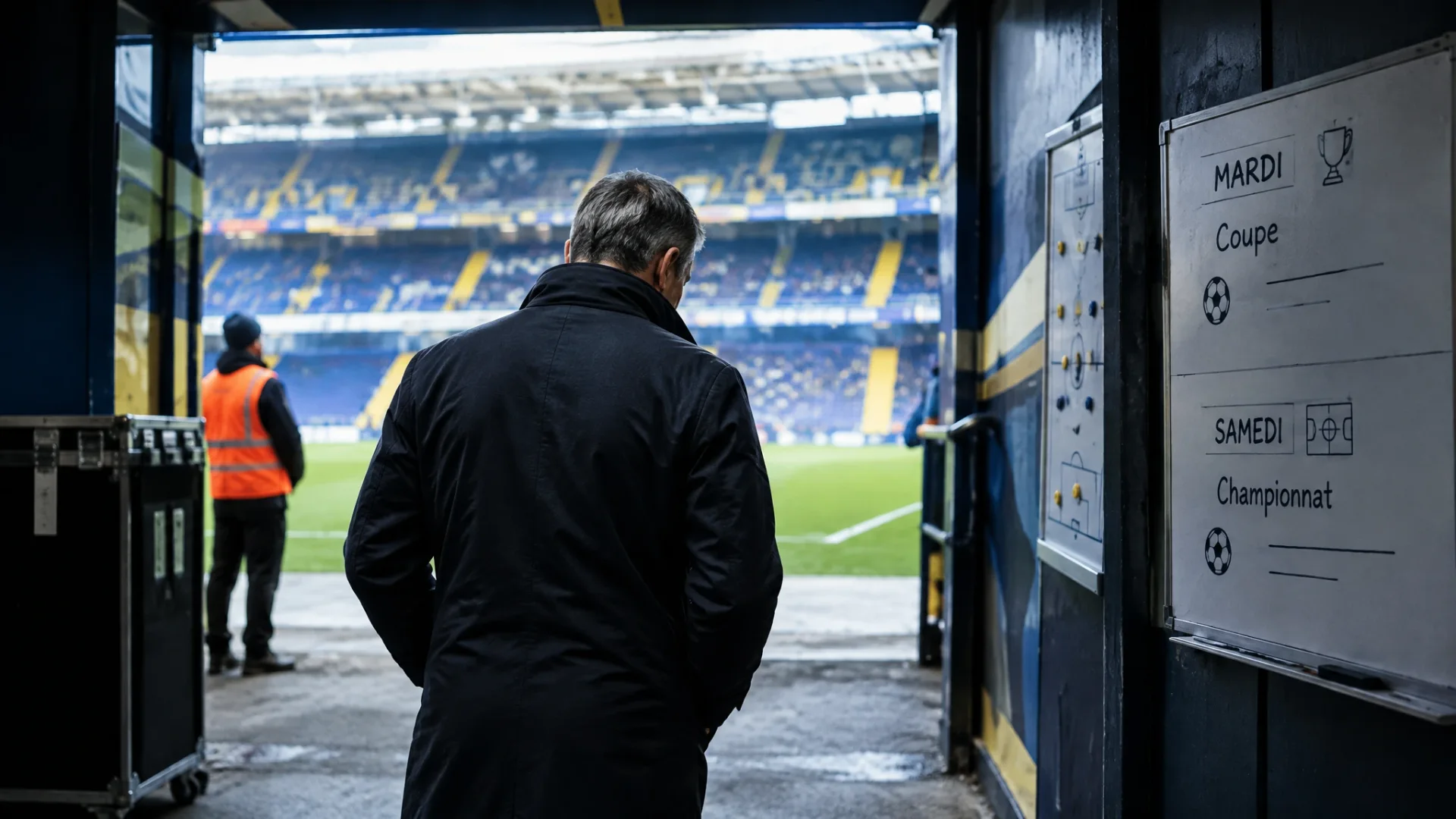
The derby triggered it, it did not explain it
It is always easy to say a derby defeat broke everything. It sounds dramatic and usually hides the more awkward truth. At Fenerbahçe, İsmail Kartal’s departure after the 2-1 loss at Galatasaray looks less like a clean footballing verdict than a decision made under pressure and then accepted because Turkish football rarely allows the pressure to dissipate. The club announced the split on 27 October, after Kartal reportedly chose to resign and the football committee discussed the matter before accepting it. The match itself left a sharp residue: Galatasaray were 2-0 up at half-time, Fenerbahçe struggled late on, and the derby finished with disciplinary noise as well as sporting damage. [1][2][3]
The useful question is not whether the move feels “understandable” in emotional terms. Of course it does. The real question is what happens when a club tears up its coaching arrangement at the worst possible point in the schedule. Then the departure stops being a response to a crisis and becomes a second crisis, one created by governance rather than by the scoreline alone.
The calendar leaves no breathing space
The Turkish calendar has no sympathy for clubs that want a clean reset. The federation’s weekly schedule places Ziraat Türkiye Kupası matches on 27, 28 and 29 October, then Süper Lig week 10 fixtures on 30 and 31 October, and 1 and 2 November. In plain English: there is no useful gap for a new staff to settle, speak, organise and be judged before the next competitive block begins. [4]
That is where impatience turns into a bad sporting policy. If the schedule gives you neither training time nor recovery time, changing coaches does not magically repair your problems. It can blur priorities instead: who sets the message, who decides what matters first, who owns the next bad 20 minutes? A club with a strong internal hierarchy answers those questions before it removes the manager.
Sources : [4] TFF ↗
The real Turkish opponent is often the moment
There is a familiar reflex in Turkey, and not only in Istanbul: to confuse urgency with clarity. The derby offered the perfect theatre — cards, incident, disciplinary review, all the usual noise — but the deeper issue is simpler and harsher. A club reacting in real time is not the same thing as a club thinking in sequence. In a league where pressure is constant, the opponent is not only the team across from you. It is the calendar, because the calendar does not care about your panic. [1][3][4]
Fenerbahçe are entitled to conclude that Kartal’s cycle had run its course. What is harder to defend is the idea that such a heavy decision can be absorbed at once, in a week that contains cup duty, league duty and disciplinary fallout. In football, timing is not a footnote. It is often the first tactical decision a club makes. This one already looks lost.
Sources : [1] TRT Haber ↗[3] TRT Haber ↗[4] TFF ↗
What supporters should watch next
Supporters do not need another slogan about rebuilding. They need to see whether the club can finally act with administrative discipline instead of nervous reflex. A coach’s exit can sometimes clarify a project; here, it mainly forces Fenerbahçe to prove it can survive its own shocks. With a cup round in midweek and the league back immediately, the margin for error is tiny. That is where a major club is judged: not by how dramatically it changes, but by how well it manages the change. [4]
So the derby was not only lost on the pitch. It was lost in the timing, in the rush to choose the most dramatic answer, and in that old belief that a shock decision is automatically a solution. More often, it is just another problem that has to be lived with.
Sources : [4] TFF ↗
Read next
 Opinion
Udinese and Runjaic: patience that looks like calculation
After six straight Serie A defeats, Udinese are not only judging their coach. They are measuring what a change would do to recruitment, the dressing-room hierarchy and the next two fixtures.
 Lucien DelcourtItaly, Germany, Spain & Turkey
 Opinion
Napoli, Allegri and the very practical cost of a two-match ban
Massimiliano Allegri’s suspension is not just a discipline issue: it leaves Napoli without its coach for Monza and Juventus. How much turbulence can a title contender really absorb?
Lucien DelcourtItaly, Germany, Spain & Turkey